Some Thoughts When Comparing AC Replacement Estimates
(And Why There’s No Such Thing as a “Free Lunch” in HVAC)
Spring is when AC estimates start rolling in. And if you’ve gathered a few quotes, you’ve probably noticed something:
They’re not all the same.
Sometimes they’re not even close.
One company might be thousands higher. Another might be shockingly low. And it leaves homeowners wondering:
“Why does it cost this much?”
“Am I overpaying?”
“Is the cheap one too good to be true?”
Let’s walk through how to look at an estimate the right way — especially here in the Denver metro area.
First: What Is a Normal Price for a 3-Ton 14 SEER AC in Denver?
For a straightforward 3-ton, 14 SEER air conditioner replacement (coil, condenser, basic materials, labor), typical installed pricing in the Denver metro area falls roughly in this range:
$5,500 – $7,500
That assumes:
- Standard residential install
- No major ductwork changes
- No electrical panel upgrades
- No line set replacement complications
- No extreme attic or roof access challenges
Now, could you see numbers outside that range? Yes.
But that range is generally where responsibly priced companies tend to land.
If You See $9,000+ for a 14 SEER…
That’s on the high side.
Sometimes it’s justified:
- High overhead company
- Large marketing budgets
- Commission-based sales structure
- Long labor warranties built into pricing
- Financing costs baked into margins
But sometimes it’s simply a pricing model built around large profit margins.
It doesn’t automatically mean they’re bad — but you should understand what you’re paying for.
If You See $4,000 or Less…
That’s where you need to slow down.
There are very few scenarios where a licensed, insured company can properly replace a 3-ton AC in Denver for that price and still operate a healthy business.
Which brings us to an uncomfortable truth.
Why Does It Cost So Much?
Let’s break it down simply.
When you pay $6,500 for an AC replacement, you are not just buying equipment.
You are paying for:
- Equipment cost (condenser + coil)
- Refrigerant
- Sheet metal materials
- Electrical components
- Permits and inspections
- Skilled labor
- Truck expenses
- Fuel
- Insurance (liability + workers comp)
- Licensing
- Office support
- Warranty reserves
- Payroll taxes
- Tools and maintenance
- Callbacks and warranty coverage
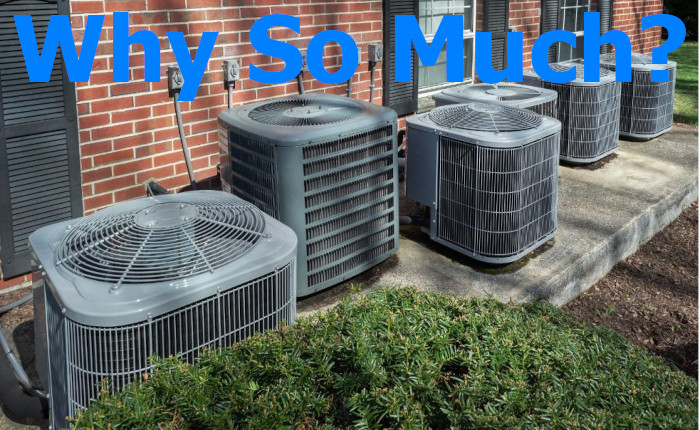
Most homeowners only see the condenser sitting outside. They don’t see the infrastructure required to keep a company operational and accountable.
A healthy HVAC company has overhead. And overhead isn’t greed — it’s what keeps the doors open next year if something goes wrong.
The Reality: There Are No Free Lunches
If one estimate is dramatically lower than the rest, one of these is usually happening:
- Corners are being cut
- The installer isn’t licensed or insured
- Permits won’t be pulled
- Warranty labor coverage is weak or nonexistent
- Installation quality will be rushed
- The company won’t be around long
That “cheap” system often costs more later on:
- Premature failures
- Efficiency loss
- Refrigerant leaks
- Comfort problems
- Resale inspection issues
Saving money long-term isn’t guaranteed by choosing the lowest bidder in mechanical work.
On the Other End: Why Some Companies Are Way Above Market
Just as concerning as ultra-low bids are extremely high bids.
Large companies often carry:
- High advertising budgets
- Commission-heavy sales teams
- Large management structures
Those costs have to be recovered somewhere.
That doesn’t automatically mean their work is bad — on the contrary, these companies are where some of the best technicians thrive, providing incredible value to clients. However, it does mean you’re funding more than just installation labor.
How to Properly Compare Estimates
Instead of just comparing bottom-line price, look at:
1. Scope of Work
- Is a new evaporator coil included?
- Are they flushing or replacing the line set?
- Are permits included or additional?
- Is a new thermostat included?
2. Warranty
- Parts warranty length?
- Labor warranty?
- Who handles warranty service?
- Does their reputation back up their claims?
3. Installation Details
- Will they pressure test?
- Will they evacuate properly to 500 microns?
- Will they verify airflow?
- Will they check static pressure?
Those steps matter more than brand names in many cases.
What a Fair Price Usually Reflects
When you see an estimate in that $5,500–$7,500 range for a 3-ton 14 SEER system in Denver, that typically means:
- The company can pay employees properly
- They carry insurance
- They stand behind their work
- They aren’t operating on razor-thin margins
- They aren’t wildly inflating profit
This can be the sweet spot for many homeowners.
Final Thought
Replacing an air conditioner is a significant investment. It’s not a small appliance — it’s a mechanical system that affects comfort, energy use, and resale value for the next 10–15 years.
If an estimate is far lower than normal, it’s fair to ask:
“What am I not getting?”
And if it’s far higher, it’s fair to ask:
“What exactly am I paying extra for?”
Most of the time, the best decision isn’t the cheapest or the most expensive. It’s the one that reflects fair pricing, solid workmanship, and a company that will still be around when you need them.
Because in HVAC — like most things — there really aren’t free lunches.
Premier Mechanical – www.claimyourcomfort.com – 720.207.6812.